California's COMPETE Act and the Recovery of the Antitrust Tradition
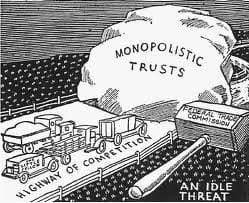
On July 21, 2026, the California Chamber of Commerce began spending millions of dollars to defeat a single bill. The campaign opened with a thirty-second advertisement and a slogan, urging Californians to "tell Sacramento we can't afford AB 1776."[1] The advertisement warns that the bill will raise prices, end customer discounts and price-matching programs, saddle small businesses with compliance costs heavy enough to bankrupt them, and wipe out jobs across the state.[2] It is a disciplined piece of persuasion, and it is most revealing in what it leaves out. Across a statewide message built to alarm, the Chamber never tells the viewer what AB 1776 actually does. The audience is handed a list of consequences and never given the law said to produce them.
That law is the COMPETE Act, and its core is narrow enough to state in a sentence. It would let California's antitrust statute reach the conduct of a single dominant firm, which the statute today does not clearly reach at all. The change is real and consequential, and it is also the kind of change that becomes hard to oppose once it is named plainly, which is a fair explanation for why the campaign declines to name it. This essay takes up the argument the advertisement avoids. It traces how California and the country arrived at a point where a state must legislate simply to reach monopoly conduct, describes what the COMPETE Act does and why, and examines each of the Chamber's public objections in turn. It ends with the larger account the Chamber has chosen not to give, of the social costs that a narrow antitrust has allowed to gather, and of why competition policy belongs in any serious response to them.
How the country narrowed its own antitrust law
The Sherman Act of 1890 was written against concentration. Section 1 reached restraints of trade and Section 2 reached monopolization, and both were understood in their era as answers to the trusts then consolidating American industry.[3] Judge Learned Hand gave the classical statement of that purpose half a century later in the Alcoa case, reading the Act as an expression of Congress's "desire to put an end to great aggregations of capital because of the helplessness of the individual before them."[4] Hand wrote that "immunity from competition is a narcotic, and rivalry is a stimulant, to industrial progress," and he understood the statute to reflect a considered social preference for an economy of many independent producers over one whose participants must accept the direction of a few.[5] The Supreme Court had already dissolved the original Standard Oil combination on the same understanding.[6] Antitrust in this period was a law about the structure of economic power and its relation to individual independence.
California built on that foundation. The Cartwright Act of 1907 is the state's principal antitrust statute, and California courts have long described it as "broader in range and deeper in reach than the Sherman Act."[7] Yet the Cartwright Act carried a structural limit from its origins. It was drafted around the "trust," a combination of two or more actors, and California courts have accordingly read it to reach concerted action while leaving the unilateral conduct of a single dominant firm outside its terms.[8] For most of the statute's life this gap drew little attention, because federal law was understood to police monopoly and the state law supplied additional reach against agreements.
The federal understanding then changed. Beginning in the 1970s, an intellectual movement centered at the University of Chicago recast the purpose of antitrust around a single measure. Robert Bork's The Antitrust Paradox argued that the law should serve only consumer welfare, by which he meant allocative efficiency expressed in prices and output.[9] The Supreme Court adopted the phrase, describing the Sherman Act in Reiter v. Sonotone Corp. as "a 'consumer welfare prescription,'" quoting Bork directly.[10] What followed over the next three decades was a steady contraction of single-firm liability. In Verizon Communications Inc. v. Trinko, the Court declined to recognize any general duty for a monopolist to deal with its rivals.[11] In Brooke Group it required a predatory-pricing plaintiff to prove both below-cost pricing and a dangerous probability that the defendant would later recoup its losses, a burden that few plaintiffs can carry.[12] In linkLine it rejected price-squeeze claims where no duty to deal existed.[13] In Ohio v. American Express Co. it required plaintiffs challenging a two-sided platform to prove net harm across both sides of the market at once.[14] The cumulative effect was to make monopolization cases under federal law difficult to win even against firms of extraordinary scale.
A revival of the older tradition followed the contraction. Scholars associated with what is now called the neo-Brandeisian school argued that a price-centered antitrust had lost the capacity to see the harms it was created to address. Lina Khan's Amazon's Antitrust Paradox showed how a firm could achieve durable dominance while holding prices low, escaping a standard that looks only at price.[15] Tim Wu's The Curse of Bigness recovered the founding purpose of the law as a check on concentrated power and its threat to self-government.[16] It was against this background that the California Law Revision Commission, at the Legislature's direction, studied whether the Cartwright Act should be modernized. The Commission concluded that the statute's silence on single-firm conduct was a genuine gap and recommended that California act to close it.[17] AB 1776 is the legislative product of that study.
What the COMPETE Act does
The bill's central move is to extend the Cartwright Act to unilateral conduct. It amends the statutory definition of a "trust" so that a combination of "capital, skill, or acts" may be formed by "one or more persons" rather than the two or more the statute has always required.[18] It then adds an operative prohibition making it unlawful for one or more persons to act in restraint of trade or to monopolize or monopsonize, to attempt to do so, or to maintain a monopoly or monopsony.[19] The reference to monopsony is relevant because it brings the buyer side of the market, including the market for labor, within the statute's express reach.
The bill also departs from the federal limiting doctrines that had made single-firm cases so hard to bring. It provides that liability shall not require the proof of recoupment that Brooke Group demands, nor the showing that a disadvantaged rival was as efficient as the dominant firm, and it declines to import the prior-course-of-dealing requirement that Trinko placed on refusal-to-deal claims.[20] It instructs courts to construe California antitrust law liberally to promote effective deterrence, restoring the interpretive posture that the Cartwright Act's "broader in range and deeper in reach" language always implied.[21] It works through direct evidence of market power rather than a rigid market-share threshold, and it carries forward the private right of action and treble damages that the Cartwright Act has provided since its enactment.
Two points of perspective are worth stating, because the Chamber of Commerce's opposition depends on obscuring both. First, the standard AB 1776 adopts is not exotic. A prohibition on the abuse of a dominant position, without a fixed market-share threshold, is the ordinary form of competition law across the developed world. Article 102 of the Treaty on the Functioning of the European Union prohibits "[a]ny abuse by one or more undertakings of a dominant position," and comparable abuse-of-dominance regimes operate throughout the member states of the OECD.[22] The American monopolization standard, narrowed by Trinko and its companions, is the outlier among peer jurisdictions. Second, the bill restores rather than invents. It returns California antitrust law to the structural, anti-concentration purpose that both the Sherman Act and the Cartwright Act carried at their origins, before the consumer-welfare turn narrowed the field of vision.
The Chamber's case, and why it does not hold
The Chamber's opposition rests on five claims. Taken together they form the public case against AB 1776, and each struggles under examination.
The first and most serious is the argument from novelty. Twenty-five professors at eight California universities have urged the Legislature to reject the bill, describing it as "a severe and untested departure from established antitrust principles."[23] The concern deserves a direct answer rather than a dismissal, because the demand for administrable standards is a legitimate one. The answer is that the departure is untested only within recent American law. The abuse-of-dominance standard AB 1776 adopts has decades of interpretive development in the European Union and across the OECD, giving California courts a deep body of comparative guidance to draw upon. The common law has always developed antitrust standards case by case, as it did for the rule of reason after 1911, and California courts are equipped to do the same. The Law Revision Commission examined these questions across a multi-year study before recommending the change. What the opposition frames as a leap into the unknown is closer to a return to a standard the rest of the developed world already applies.
The second claim is that the bill will produce a wave of frivolous litigation. The private right of action, however, is not a novelty AB 1776 introduces. The Cartwright Act has authorized private enforcement with treble damages since 1907, and private suits have long been a deliberate feature of American antitrust, chosen by legislatures to supplement public enforcement that no agency budget can fully supply. The rule of reason that governs these cases requires a plaintiff to prove anticompetitive effect and permits a defendant to offer procompetitive justifications, a structure that screens weak claims before they reach a jury.[24] The prediction that expanded liability will flood the courts has accompanied nearly every extension of antitrust in the statute's history and has not materialized. Deterrence of unlawful conduct is the purpose of the private action, not an unintended side effect of it.
The third claim is that the bill will chill ordinary and beneficial business conduct, ending the discounts, loyalty programs, and price-matching that consumers enjoy. This argument mistakes the reach of the standard. The rule of reason condemns only conduct whose anticompetitive harm outweighs its procompetitive benefit, and genuine discounting and loyalty programs offered by firms without market power are not exposed by a law directed at the abuses of dominant firms.[25] A dominant firm that uses below-cost pricing or exclusive dealing to foreclose rivals is doing something the antitrust laws have always been concerned to reach. The advertisement's examples, airline miles and hotel rewards, are drawn from competitive markets where no abuse-of-dominance claim could succeed. They serve the campaign as reassuring images rather than as accurate descriptions of the bill's operation.
The fourth claim is quantitative. The Chamber asserts that AB 1776 threatens roughly one trillion dollars of California gross domestic product and 1.6 million jobs over its first decade, and that the loss would deepen the state's budget deficit.[26] That figure comes from a report commissioned by the Computer and Communications Industry Association, a technology trade group among the bill's opponents, and written by its own chief economist. The projection rests on a deterrence model built from stacked assumptions about how many firms would abandon procompetitive conduct and by how much, rather than on any observed effect. It should be read as advocacy. The Chamber's use of it also sits awkwardly beside its fifth claim.
The fifth claim is that no one has identified a problem the bill would solve, after months of hearings. This assertion depends entirely on the measure of harm one is willing to use. Under a standard that looks only at short-run consumer prices, much of what concentration does to an economy is invisible by design. Once the aperture widens, the evidence of a problem is substantial. Markups charged over marginal cost by American firms rose from roughly 21 percent in 1980 to about 61 percent by 2016, with the increase concentrated among the largest firms.[27] More than three-quarters of American industries grew more concentrated between the late 1990s and the mid-2010s, and firms in the concentrating industries earned higher profits without corresponding gains in efficiency.[28] The Council of Economic Advisers documented the same trend across the economy.[29] The problem the Chamber says no one has identified is the very phenomenon that a price-centered antitrust was constructed not to detect.
What the consumer welfare era left unaddressed
The deepest case for the COMPETE Act lies in the harms that the consumer welfare standard was built to overlook. By measuring competition through the prices paid by end consumers, the standard leaves out the effects of concentrated power on workers, suppliers, and the structure of opportunity itself. Scholars have argued for some years that this omission is not a marginal gap but the standard's central defect, and that a competition law worthy of the name must account for harms that a price index cannot register.[30] The social strains now visible across the American economy trace in significant part to that blind spot.
Consider wages. A firm with power over a labor market can suppress pay in the same way a seller with market power can raise prices, and the evidence that American labor markets are concentrated is now considerable. Most local labor markets exceed the concentration thresholds that antitrust treats as presumptively dangerous in product markets, and moving from a less concentrated to a more concentrated market is associated with materially lower wages.[31] Employer collusion has compounded the structural problem, as when a majority of major franchise chains were found to bind their franchisees with no-poach clauses that barred them from hiring one another's workers.[32] Wage stagnation is what a labor market under monopsony looks like, and AB 1776's express reach to monopsony equips private plaintiffs and the state alike to challenge it.
The same pattern recurs across the household budget. In housing, the Department of Justice and a coalition of states have alleged that a common pricing algorithm allowed competing landlords to coordinate rents that they would otherwise have set independently, raising the cost of shelter for millions of tenants.[33] Concentration in homebuilding has meanwhile left a shrinking number of national firms controlling a growing share of new construction, which bears directly on why housing is scarce and expensive. In consumer markets more broadly, firms with market power used the supply shocks of the recent inflation as cover to widen margins, so that concentration contributed to the price increases that eroded real incomes.[34] In freight and logistics, a handful of ocean-carrier alliances came to dominate the movement of goods, charging record rates during the pandemic and prompting Congress to pass the Ocean Shipping Reform Act of 2022, while decades of rail consolidation left the country with a bare handful of major carriers.[35] Each of these is a cost that lands on families and on the firms that must ship, build, and hire, and none of it registers cleanly as a consumer-price effect of the kind the prevailing standard was designed to measure.
The effects reach into demographic life as well, though here the causal chain is longer and the claim should be made with corresponding care. When housing and the other fixed costs of forming a household climb faster than incomes, family formation becomes harder, and the economic literature finds that housing costs bear on fertility decisions, with the direction of the effect depending on whether a household owns or rents.[36] It would overstate the evidence to attribute declining birth rates to market concentration in any direct way. The more defensible point is that an economy in which the essentials of an independent life grow steadily less affordable is one in which people defer or forgo the commitments that a stable society depends upon, and that competition policy is one of the few tools capable of addressing the underlying costs through private action rather than public subsidy.
That last distinction is the heart of the matter. The alternative to a competition law that empowers private actors to discipline concentrated power is a growing reliance on direct government intervention, on price controls and subsidies and regulatory mandates, to manage symptoms the market is no longer structured to correct. Direct intervention is a blunt and unreliable instrument, subject to capture and to the shifting priorities of each administration. A robust antitrust law disperses that responsibility, letting injured competitors, workers, and consumers act as private attorneys general to keep markets open. The COMPETE Act is a step in that direction. It is not a complete answer to wage stagnation or the housing shortage or the cost of moving goods, and it should not be sold as one. It restores a legal tool that the consumer-welfare era had quietly disabled, and it does so along the lines that the rest of the developed world already follows.
It is worth noticing what the opposition has not offered. The Chamber's campaign identifies a set of feared costs and stops there. It proposes no alternative remedy for the concentration that the empirical record documents, no answer to monopsony in the labor market, no response to algorithmic coordination in housing, no plan for the transportation bottlenecks that raise the price of everything that moves. A party genuinely concerned with the health of California's economy might be expected to bring a competing solution to problems of this scale. The Chamber has brought an advertisement.
Conclusion
The California Chamber of Commerce can plainly afford its campaign against AB 1776. The multimillion-dollar budget, the statewide advertising, and the coalition of the state's largest firms are evidence of resources, and of the stakes that dominant incumbents perceive in a law that would let a single firm's conduct be tested against the antitrust laws for the first time in California's history. The question the campaign asks Californians to consider, whether they can afford the COMPETE Act, is worth turning around. The relevant cost is the one already being paid, in wages held down by concentrated labor markets, in rents lifted by coordinated pricing, in the widening distance between what an independent life requires and what most families can command. That cost accrued during the decades when antitrust was taught to look only at prices and to find, reliably, that nothing was wrong. AB 1776 proposes to restore the older and wider view, the one Learned Hand described, in which the law concerns itself with the aggregations of capital and the helplessness of the individual before them. The bill is a modest and overdue step back toward that understanding, and the case against it, stripped of the advertising, comes down to the preferences of those who have done best under the arrangement it would change.
Footnotes
- Press Release, Cal. Chamber of Com., CalChamber Launches Statewide Campaign to Oppose AB 1776 (July 21, 2026) (announcing a multimillion-dollar public-awareness campaign urging Californians to "tell Sacramento we can't afford AB 1776"). ↩︎
- Id. (describing an initial thirty-second advertisement asserting that the bill would raise prices, eliminate customer discounts and price-matching programs, impose compliance burdens capable of bankrupting small businesses, and eliminate jobs).
- Sherman Act, 15 U.S.C. §§ 1-2 (2018) (declaring unlawful contracts in restraint of trade and the act of monopolizing any part of interstate commerce).
- United States v. Aluminum Co. of Am. (Alcoa), 148 F.2d 416, 428 (2d Cir. 1945) (reading the Sherman Act as reflecting a congressional "desire to put an end to great aggregations of capital because of the helplessness of the individual before them").
- Id. at 427 (observing that "immunity from competition is a narcotic, and rivalry is a stimulant, to industrial progress," and describing a social preference for "a system of small producers, each dependent for his success upon his own skill and character").
- Standard Oil Co. of N.J. v. United States, 221 U.S. 1 (1911) (adopting the rule of reason and ordering the dissolution of the Standard Oil combination).
- Cartwright Act, Cal. Bus. & Prof. Code §§ 16700-16770 (West 2024) (establishing California's principal prohibitions on combinations in restraint of trade).
- Cianci v. Superior Court, 40 Cal. 3d 903, 923 (1985) (describing the Cartwright Act as "broader in range and deeper in reach than the Sherman Act"); see also Cal. Law Revision Comm'n, Recommendation: Antitrust Law: Single-Firm Conduct, Study B-750 (2026) (concluding that the Cartwright Act reaches concerted conduct but not the unilateral conduct of a single firm).
- Robert H. Bork, The Antitrust Paradox: A Policy at War with Itself (1978) (contending that antitrust should pursue only consumer welfare understood as allocative efficiency).
- Reiter v. Sonotone Corp., 442 U.S. 330, 343 (1979) (quoting Bork and describing the Sherman Act as "a 'consumer welfare prescription'").
- Verizon Commc'ns Inc. v. Law Offices of Curtis V. Trinko, LLP, 540 U.S. 398, 408-11 (2004) (declining to impose a general antitrust duty on a monopolist to deal with its rivals).
- Brooke Group Ltd. v. Brown & Williamson Tobacco Corp., 509 U.S. 209, 222-24 (1993) (requiring a predatory-pricing plaintiff to prove below-cost pricing and a dangerous probability of recoupment).
- Pacific Bell Tel. Co. v. linkLine Commc'ns, Inc., 555 U.S. 438, 449-52 (2009) (rejecting a price-squeeze claim where the defendant owed no antitrust duty to deal at wholesale).
- Ohio v. American Express Co., 585 U.S. 529 (2018) (requiring plaintiffs challenging a two-sided transaction platform to demonstrate net anticompetitive effects across both sides of the market).
- Lina M. Khan, Amazon's Antitrust Paradox, 126 Yale L.J. 710 (2017) (arguing that a price-centered antitrust cannot perceive the competitive harms of platform dominance).
- Tim Wu, The Curse of Bigness: Antitrust in the New Gilded Age (2018) (recovering antitrust's origins as a check on concentrated private power and its threat to democratic self-government).
- Cal. Law Revision Comm'n, Recommendation: Antitrust Law: Single-Firm Conduct, Study B-750 (2026) (recommending that California extend the Cartwright Act to reach single-firm conduct after a multi-year study). ↩︎
- Cal. Bus. & Prof. Code § 16720 (as proposed to be amended by Assemb. B. 1776, 2025-2026 Reg. Sess. (Cal. 2026)) (redefining a "trust" as a combination of capital, skill, or acts "by one or more persons").
- Assemb. B. 1776, 2025-2026 Reg. Sess. (Cal. 2026) (proposed Cal. Bus. & Prof. Code § 16731) (making it unlawful for one or more persons to restrain trade or to monopolize or monopsonize, to attempt to do so, or to maintain a monopoly or monopsony).
- Id. (proposed Cal. Bus. & Prof. Code § 16732) (providing that liability shall not require proof of recoupment or of a disadvantaged rival's equal efficiency).
- Id. (proposed Cal. Bus. & Prof. Code § 16733) (directing courts to liberally interpret California antitrust law to promote effective deterrence of violations).
- Consolidated Version of the Treaty on the Functioning of the European Union art. 102, 2012 O.J. (C 326) 47 (prohibiting "[a]ny abuse by one or more undertakings of a dominant position within the internal market"); see also OECD, Abuse of Dominance and Monopolisation, OCDE/GD(96)131 (1996) (comparing the prevalent abuse-of-dominance framework with the narrower United States monopolization standard).
- Chris Micheli, Antitrust Fight Heats Up Ahead of Appropriations Hearing, Capitol Weekly (2026) (reporting that twenty-five professors from eight California universities urged rejection of AB 1776 as "a severe and untested departure from established antitrust principles").
- Leegin Creative Leather Prods., Inc. v. PSKS, Inc., 551 U.S. 877, 885-87 (2007) (describing the rule of reason as weighing anticompetitive harm against procompetitive justification).
- Ohio v. American Express Co., 585 U.S. 529, 541-42 (2018) (setting out the burden-shifting structure by which procompetitive justifications are credited under the rule of reason).
- Trevor Wagener, Comput. & Commc'ns Indus. Ass'n, The Rushed COMPETE Act Could Cost California $1 Trillion in GDP and 1.6 Million Jobs in 10 Years (2026) (projecting the asserted losses through a deterrence model built on assumptions about foregone procompetitive conduct).
- Jan De Loecker, Jan Eeckhout & Gabriel Unger, The Rise of Market Power and the Macroeconomic Implications, 135 Q.J. Econ. 561 (2020) (estimating that average markups rose from roughly 21 percent over marginal cost in 1980 to about 61 percent by 2016, concentrated among the largest firms).
- Gustavo Grullon, Yelena Larkin & Roni Michaely, Are U.S. Industries Becoming More Concentrated?, 23 Rev. Fin. 697 (2019) (finding that more than three-quarters of U.S. industries grew more concentrated over roughly two decades, with higher profits unexplained by efficiency).
- Council of Econ. Advisers, Benefits of Competition and Indicators of Market Power (Issue Brief Apr. 2016) (documenting rising concentration and returns to capital across the United States economy).
- See Lina Khan & Sandeep Vaheesan, Market Power and Inequality: The Antitrust Counterrevolution and Its Discontents, 11 Harv. L. & Pol'y Rev. 235 (2017) (arguing that the consumer welfare standard ignores how market power harms workers and suppliers and redistributes wealth upward); Marshall Steinbaum & Maurice E. Stucke, The Effective Competition Standard: A New Standard for Antitrust, 87 U. Chi. L. Rev. 595 (2020) (contending that the consumer welfare standard is too narrow to capture harms to labor, innovation, and the competitive process).
- José Azar, Ioana Marinescu & Marshall Steinbaum, Labor Market Concentration, 57 J. Hum. Res. S167 (2022) (finding most local labor markets highly concentrated and associating higher concentration with materially lower posted wages); see also Suresh Naidu, Eric A. Posner & E. Glen Weyl, Antitrust Remedies for Labor Market Power, 132 Harv. L. Rev. 536 (2018) (arguing that antitrust should address widespread monopsony in labor markets).
- Alan B. Krueger & Orley Ashenfelter, Theory and Evidence on Employer Collusion in the Franchise Sector, 57 J. Hum. Res. S324 (2022) (finding that a majority of major franchisors' contracts contained no-poach clauses barring franchisees from hiring one another's workers).
- Complaint, United States v. RealPage, Inc., No. 1:24-cv-00710 (M.D.N.C. filed Aug. 23, 2024) (alleging that competing landlords used a shared pricing algorithm to align rents and raise the price of housing).
- Isabella M. Weber & Evan Wasner, Sellers' Inflation, Profits and Conflict: Why Can Large Firms Hike Prices in an Emergency?, 11 Rev. Keynesian Econ. 183 (2023) (arguing that firms with market power used supply shocks as cover to widen margins, contributing to inflation).
- Ocean Shipping Reform Act of 2022, Pub. L. No. 117-146, 136 Stat. 1272 (strengthening federal oversight of ocean carriers amid pandemic-era congestion and record rates charged by a small number of carrier alliances).
- Lisa J. Dettling & Melissa S. Kearney, House Prices and Birth Rates: The Impact of the Real Estate Market on the Decision to Have a Baby, 110 J. Pub. Econ. 82 (2014) (finding that housing costs affect fertility, with the direction of the effect depending on whether a household owns or rents its home).