Aftermarket Monopolization After Intuitive Surgical
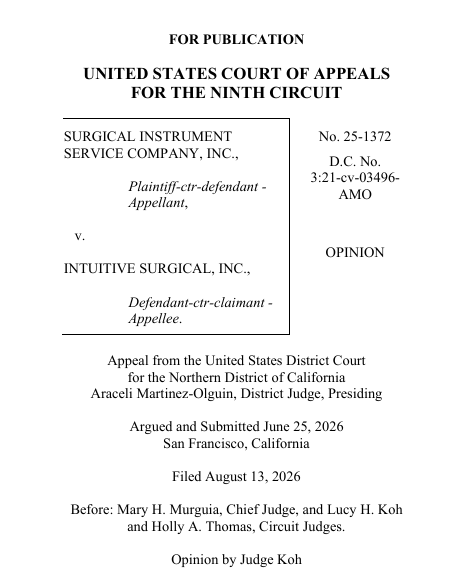
Intuitive Surgical installs a counter in every EndoWrist, the wristed instrument that its da Vinci surgical robot uses to cut and suture inside a patient. The counter is preset to roughly ten uses, which the company calls “lives.” Each time a surgeon activates the instrument the counter falls by one, and once it reaches zero the EndoWrist stops working, whatever its physical condition, and the hospital must buy a new one.[1] The counter is the basis of a business model. Intuitive earns its revenue from the recurring sale of the instruments that the da Vinci cannot operate without, and comparatively little from the sale of the robot itself. The company holds more than 99% of the market for the robots and 100% of the market for the instruments.[2] On August 13, 2026, in Surgical Instrument Service Co. v. Intuitive Surgical, Inc., the Ninth Circuit held that a company seeking to repair those instruments may challenge that arrangement without carrying the special evidentiary burden that antitrust law reserves for a different kind of case.[3]
The holding is narrow in statement and large in consequence. At trial, the district court instructed the jury that, to prove that its proposed aftermarket for instruments was a valid antitrust market, SIS had to establish a set of factors drawn from the Supreme Court’s decision in Eastman Kodak Co. v. Image Technical Services, Inc. and the Ninth Circuit’s decision in Epic Games, Inc. v. Apple, Inc. SIS had built its case on Intuitive’s dominance rather than on the lock-in of individual customers, offered no proof of those factors, and stipulated to judgment once the instruction was set. The Ninth Circuit held that instruction erroneous.[4] The factors, the court explained, apply only where a plaintiff cannot show that the defendant holds power in the competitive primary market, the foremarket, and must therefore build its case on the defendant’s power over its own locked-in customers in a market downstream. Where the defendant already dominates the foremarket, the ordinary tools of market definition suffice, and the plaintiff need prove no more than it would in any other tying case. The significance of the decision lies in what it refuses to do. It declines to turn a doctrine that once enlarged the reach of antitrust plaintiffs into a barrier that would shelter the most dominant firms of all.
I. Antitrust Before Kodak
The relevant law begins with two sentences of the Sherman Act. Section 1 forbids contracts, combinations, and conspiracies in restraint of trade. Section 2 forbids monopolizing and attempts to monopolize.[5] The purpose the Supreme Court has assigned to the Act is to protect competition and to prevent the accumulation of monopoly power.[6]Most antitrust claims share a threshold requirement. Before a court can assess whether challenged conduct harms competition, it must define the relevant market in which the harm is said to occur, because the definition of that market is what lets a plaintiff show, usually by inference from market share, that the defendant holds power within it.[7] Market power has a settled meaning. It is the power to force a purchaser to do something he would not do in a competitive market.[8]
Tying claims show why market power matters. A tie exists when a seller conditions the sale of one product, the tying product, on the buyer’s purchase of a second, the tied product. The law forbids the practice because a seller with power over the tying product can use that power to foreclose competition in the market for the tied product, and so proof that the defendant holds appreciable power in the tying-product market is an element of the claim.[9]
Ties between a durable good and its consumable components are among the oldest cases of this kind. A foremarket is the primary market for a durable good, a car or a copier or a surgical robot. An aftermarket is the derivative market for the parts, service, and supplies that the durable good needs in order to function.[10] In 1936, in International Business Machines Corp. v. United States, the Supreme Court condemned a tie of exactly this shape. IBM leased tabulating machines and required its lessees to use only IBM-made cards, and the Court held the requirement an unlawful use of IBM’s power in the machine foremarket to monopolize the card aftermarket.[11] Cases of this kind, the Court would later confirm, involve no exception to the usual antitrust analysis. An aftermarket is treated the same as every other separate market, and the plaintiff makes its case through ordinary market definition and ordinary proof of power.[12] For most of the twentieth century that was the whole of the doctrine. A firm with power in the foremarket that used it to capture the aftermarket had violated the Sherman Act, and nothing turned on any special showing about consumer knowledge or the cost of switching.
II. Kodak and the Aftermarket Turn
Kodak arose from a harder problem. The plaintiffs were independent service organizations that repaired Kodak photocopiers, and they sued after Kodak adopted policies that made it more difficult for them to compete in servicing Kodak equipment.[13] The difficulty for their case was that Kodak did not dominate the foremarket. It sold copiers in competition with other manufacturers and held no market power in the equipment market at all. Under the older logic, that fact should have defeated a tying theory, because a plaintiff ordinarily proves a foremarket tie by showing the defendant’s power in the foremarket. The service organizations therefore framed a different tie. They claimed that Kodak used its monopoly over Kodak-brand parts, an aftermarket in which its power was undisputed, to force customers into the separate aftermarket for Kodak service. The alleged tie ran between two aftermarkets, both downstream from a competitive foremarket.[14]
Kodak’s defense was a bright-line rule. It argued that competition in the equipment foremarket categorically precluded any finding of monopoly power in the derivative aftermarkets, on the theory that a firm that raised its aftermarket prices would lose customers when they next bought equipment, so that foremarket competition necessarily disciplines aftermarket pricing.[15] The Supreme Court rejected the rule. It recognized that a firm might retain power over its aftermarkets despite competition in the foremarket, for reasons grounded in how actual markets work. Consumers often cannot acquire the information needed to calculate the lifecycle cost of a durable good at the time they buy it, cannot always engage in lifecycle pricing even when they have the information, and once committed may be locked in by the high cost of switching to another system.[16] On that reasoning the service organizations could proceed.
Kodak is often read as an expansion of antitrust liability, and the dissent treated it as one, warning that the decision threatened a torrent of litigation over single-brand aftermarkets.[17] The expansion ran in a particular direction and within a stated limit. The Court confined its holding to the circumstance before it, in which the defendant lacked market power in a competitive foremarket, and it expressly declined to address the situation in which a defendant possesses foremarket power.[18] The distinction did not escape the dissent, which agreed that a manufacturer’s tie of foremarket equipment to aftermarket derivatives violates the antitrust laws when the manufacturer holds monopoly power in the equipment foremarket.[19] What Kodak added was a route for plaintiffs who could not clear the ordinary foremarket-power bar. It said nothing to raise that bar for plaintiffs who could.
The whole of the Kodak analysis, seen correctly, is an inquiry into discipline. Its factors ask whether the information available in the foremarket and the competition among equipment sellers are enough to constrain a firm’s pricing in the aftermarket. Where the foremarket is competitive, that question is genuinely open, and the factors supply the answer. Where the foremarket is not competitive, the question does not arise.
III. Aftermarket Monopolization in the Ninth Circuit
The Ninth Circuit carried Kodak’s logic forward through a line of cases, and each shared the feature that had defined Kodak itself. In every one, the plaintiff could not establish the defendant’s power in the competitive foremarket and instead pressed a claim built on the defendant’s power in an aftermarket downstream from that competitive foremarket.
The first was Newcal Industries, Inc. v. Ikon Office Solution, decided at the pleading stage in 2008. IKON, like Kodak, held no power in the primary market, and the question was whether a plaintiff could nonetheless allege a single-brand aftermarket for IKON’s own equipment. The court allowed the claim to proceed, because the complaint offered factual allegations to rebut the economic presumption that customers make a knowing choice to restrict their aftermarket options when they sign the initial competitive contract. Competition in the initial market, the court reasoned, does not necessarily suffice to discipline anticompetitive practices in the aftermarket.[20] The reasoning was Kodak’s, applied to new facts of the same structure.
The leading modern statement is Epic Games, Inc. v. Apple, Inc., decided in 2023. Apple held roughly a 15% share of the global smartphone market, so Epic could not ground a tying claim on Apple’s power in the equipment foremarket. Epic instead defined two single-brand aftermarkets, one for iOS app distribution and one for iOS in-app payment solutions, both derived from a foremarket for smartphone operating systems, and alleged a tie between them.[21] To establish such a market, the court held, a plaintiff must satisfy four requirements: that the challenged aftermarket restrictions are not generally known when consumers make their foremarket purchase, that significant information costs prevent accurate lifecycle pricing, that significant switching costs exist, and that general market-definition principles concerning cross-elasticity of demand do not undermine the proposed single-brand market.[22] These are the requirements the parties in the present case call the Kodak/Epic factors. Six months later, in Coronavirus Reporter v. Apple, Inc., the court applied the same analysis to reject a complaint that alleged at least fifteen antitrust markets without defining any of them, a ruling that again rested on Apple’s absence of foremarket power.[23]
A pattern runs through these cases, and it is a pattern about market power. In each, the plaintiff’s difficulty was the same. The defendant did not dominate the foremarket, so foremarket competition might have disciplined its conduct downstream, and the plaintiff had to prove that the discipline had failed. The Kodak/Epic factors are the instrument for proving that failure. They test whether information gaps and switching costs let a firm without foremarket power acquire power over its own customers all the same. They stand in for the foremarket-power showing that such a plaintiff cannot make. A plaintiff who can make that showing has no need of the substitute.
IV. The Framework of Surgical Instrument Service
The district court in Surgical Instrument Service lost sight of that logic. It read the Kodak/Epic factors as a requirement that attaches whenever a plaintiff seeks to define a single-brand aftermarket, and on that reading it instructed the jury that SIS had to prove the factors to establish its aftermarket for EndoWrists. SIS, whose case rested on Intuitive’s dominance rather than on locked-in customers, had introduced no evidence of the factors, and it stipulated to judgment for Intuitive once the instruction was given.[24]
The Ninth Circuit reversed. The Kodak/Epic factors, the court held, apply only where a plaintiff cannot show the defendant’s power in the competitive foremarket, because the factors do no more than test whether foremarket competition is sufficient to discipline aftermarket conduct.[25] SIS had alleged and offered proof of something different. It contended that Intuitive used its near-total power in the foremarket for surgical robots to obtain and keep complete control of the aftermarket for the instruments those robots require, a claim of the same shape as the tie condemned in IBM. A claim of that shape is assessed under ordinary market-definition principles, with no additional factors to prove.[26]
The court gave a practical reason alongside the doctrinal one, and the practical reason exposes why the district court’s rule could not stand. Each of the principal factors presupposes the existence of foremarket alternatives. The requirement that aftermarket restrictions be generally known at the time of the foremarket purchase matters only if the buyer’s knowledge could change a foremarket decision, and the requirement of significant switching costs presupposes some other product to switch to. Where a single firm holds 99% of the foremarket, there is no alternative to learn about and nothing to switch to, and the demand for proof of these factors becomes logically incoherent.[27] The factors were designed to detect a hidden power that a competitive foremarket might conceal. They have no work to do where the power is open and complete.
The court therefore stated the framework as a choice. A plaintiff seeking to pursue an antitrust claim based on a defendant’s power in a single-brand aftermarket has two routes. It may show that the defendant holds power in the foremarket, or, if it cannot, it may satisfy the Kodak/Epic factors.[28] SIS took the first route, and its evidence of a market share above 99% cleared it comfortably. The court declined to fix any precise threshold of share or power, observing that a share of that size would meet any threshold a court might set.[29] It also rejected Intuitive’s fallback arguments, holding that Intuitive had waived its contention that SIS failed to prove pre-2019 market power, that the trial evidence supported a finding of such power in any event, and that the evidence permitted a reasonable jury to find Intuitive’s process for approving third-party instruments illusory.[30] The judgment was reversed and the case remanded for trial under the corrected instruction.
V. What the Correction Protects
The doctrinal question in Surgical Instrument Service is technical, but the commercial interest it governs is broad and concrete. Aftermarket monopolization is the legal name for a familiar commercial strategy. A firm sells a durable good once and then collects a recurring charge from the buyer who now depends on it for parts, service, and supplies. The strategy is lawful when the aftermarket is competitive, and it becomes an antitrust problem when the seller uses power to close the aftermarket to rivals. Intuitive’s use counter is a precise instrument of that strategy. It ensures that a hospital that has committed to the da Vinci system cannot extend the life of an instrument or turn to an independent repairer without Intuitive’s leave. Hospitals report that they must be able to offer the robot to recruit surgeons, which makes that commitment difficult to avoid.[31]
This is the setting in which the allocation of proof does its real work. The Kodak framework arose to help plaintiffs reach firms whose power was concealed by a competitive foremarket, firms that could hold up their own customers precisely because those customers had not seen the lock-in coming. To require the same proof of a plaintiff suing a firm that owns 99% of the foremarket would invert the framework. It would demand the most from plaintiffs in the cases where the defendant’s power is least in doubt, and it would grant the firms with the most complete dominance a shelter that firms with partial power do not enjoy. The Ninth Circuit’s correction restores the proportion the doctrine always implied. The more openly a firm dominates the foremarket, the less a plaintiff must prove about the fine mechanics of lock-in, because dominance makes those mechanics beside the point.
The ruling leaves a good deal unsettled, and its limits are worth stating plainly. It fixes the burden of proof and the shape of the market inquiry, and it returns the case to the district court for a trial on the merits. It does not decide that Intuitive violated the Sherman Act, and the questions a jury will now weigh, whether the instrument aftermarket is properly drawn, whether Intuitive’s restrictions foreclosed competition, and whether its safety justifications hold, remain open.[32] What the decision settles is the prior question of who must prove what, and it settles it in a way that keeps the antitrust laws available against the oldest and simplest form of aftermarket power. For the growing set of industries built on proprietary parts, metered supplies, and controlled repair, from medical devices to printers to farm equipment, that prior question often decides whether a plaintiff reaches trial at all. The Ninth Circuit has answered it by treating a firm’s dominance as what it is, rather than as a reason to make the firm’s challengers prove more.
[1]Surgical Instrument Serv. Co. v. Intuitive Surgical, Inc., No. 25-1372, slip op. at 8 (9th Cir. Aug. 13, 2026) (describing the preset use counter installed in each EndoWrist and Intuitive’s plan to draw recurring revenue from high-margin “resposable” instruments rather than from sales of the robot itself).
[2]Id. at 6 (stating that Intuitive holds more than 99% of the market for minimally invasive soft-tissue surgical robots and 100% of the market for EndoWrist attachment instruments).
[3]Id. at 6, 26-27 (holding the district court’s jury instruction erroneous, explaining that the Kodak/Epic factors apply only where a plaintiff cannot show the defendant’s power in the competitive foremarket, and reversing).
[4]Id. at 15, 30 (holding the jury instruction erroneous because proof of the Kodak/Epic factors is required only when a plaintiff cannot establish the defendant’s foremarket power).
[5]15 U.S.C. §§ 1-2 (2018) (forbidding, in Section 1, contracts and conspiracies in restraint of trade, and, in Section 2, monopolizing and attempts to monopolize).
[6]Standard Oil Co. v. Fed. Trade Comm’n, 340 U.S. 231, 249 (1951) (describing the goal of the antitrust laws as protecting competition and preventing monopoly power).
[7]See Rebel Oil Co. v. Atl. Richfield Co., 51 F.3d 1421, 1434 (9th Cir. 1995) (explaining that a plaintiff must define the relevant market because market power is ordinarily inferred from the defendant’s share of that market).
[8]Jefferson Par. Hosp. Dist. No. 2 v. Hyde, 466 U.S. 2, 14 (1984) (defining market power as the power to force a purchaser to do something he would not do in a competitive market), abrogated on other grounds by Ill. Tool Works Inc. v. Indep. Ink, Inc., 547 U.S. 28 (2006).
[9]See Cascade Health Sols. v. PeaceHealth, 515 F.3d 883, 912 (9th Cir. 2008) (explaining that a tie allows a seller with power over the tying product to foreclose competition in the market for the tied product); see also Paladin Assocs., Inc. v. Mont. Power Co., 328 F.3d 1145, 1159 (9th Cir. 2003) (identifying appreciable economic power in the tying-product market as an essential element of a tying claim).
[10]See Phillip E. Areeda & Herbert Hovenkamp, Antitrust Law: An Analysis of Antitrust Principles and Their Application ¶ 564b (2026 Cumulative Supp. 2018-2023) (defining a foremarket as the primary market for a durable good and an aftermarket as the derivative market for the components and services that good requires).
[11]Int’l Bus. Machs. Corp. v. United States, 298 U.S. 131, 135-36 (1936) (holding unlawful IBM’s use of its power in the tabulating-machine foremarket to require its lessees to use cards of IBM’s own manufacture).
[12]Eastman Kodak Co. v. Image Technical Servs., Inc., 504 U.S. 451, 479 n.29 (1992) (explaining that foremarket/aftermarket ties involve no exception to the usual antitrust analysis and that an aftermarket is treated the same as every other separate market).
[13]Kodak, 504 U.S. at 455 (describing the independent service organizations’ challenge to Kodak’s policies restricting their ability to service Kodak copiers).
[14]Id. at 459 (explaining that the service organizations alleged a tie between the aftermarket for Kodak parts and the aftermarket for Kodak service).
[15]Id. at 471-72, 486 (rejecting Kodak’s argument that competition in the equipment foremarket categorically precludes market power in the derivative aftermarkets).
[16]Id. at 473-77 (recognizing that information costs, an inability to engage in lifecycle pricing, and switching costs may permit a firm to exercise aftermarket power despite foremarket competition).
[17]Id. at 489 (Scalia, J., dissenting) (warning that the decision threatens to release a torrent of litigation).
[18]Id. at 454-55 (limiting the holding to whether a lack of market power in the primary equipment market precludes market power in derivative aftermarkets); id. at 465 n.10 (declining to consider a case in which the defendant possesses foremarket power).
[19]Id. at 499 (Scalia, J., dissenting) (acknowledging that a manufacturer’s tie of foremarket equipment to aftermarket derivatives violates the antitrust laws when the manufacturer holds monopoly power in the equipment foremarket).
[20]Newcal Indus., Inc. v. Ikon Office Sol., 513 F.3d 1038, 1048, 1050 (9th Cir. 2008) (permitting the plaintiff to proceed where IKON lacked primary-market power because the complaint alleged facts rebutting the presumption that competition in the initial market disciplines the aftermarket).
[21]Epic Games, Inc. v. Apple, Inc., 67 F.4th 946, 966-67, 970 (9th Cir. 2023) (explaining that Apple’s roughly 15% share of the smartphone market led Epic to define two single-brand aftermarkets derived from a foremarket for operating systems).
[22]Id. at 977 (setting out the four requirements a plaintiff must satisfy to establish a single-brand aftermarket).
[23]Coronavirus Reporter v. Apple, Inc., 85 F.4th 948, 956 (9th Cir. 2023) (rejecting a complaint that alleged at least fifteen antitrust markets without defining them, on reasoning that incorporated Epic’s determination that Apple lacked foremarket power).
[24]Surgical Instrument Serv., slip op. at 13-14 (recounting that SIS offered no evidence of the Kodak/Epic factors and stipulated to judgment once the district court decided to give the instruction).
[25]Id. at 27 (holding that the Kodak/Epic factors apply only where a plaintiff cannot show market power in the competitive foremarket, because the factors test whether foremarket competition suffices to discipline aftermarket conduct).
[26]Id. at 28 (explaining that SIS brought a standard foremarket/aftermarket tying claim like the claim in IBM, to be assessed under ordinary market-definition principles).
[27]Id. at 28-29 (reasoning that a demand for proof of the factors is logically incoherent where a dominant foremarket leaves consumers no alternative to learn about and nothing to which they might switch).
[28]Id. at 29-30 (setting out the two routes by which a plaintiff may establish an antitrust claim based on the defendant’s power in a single-brand aftermarket).
[29]Id. at 30 n.7 (declining to fix a precise market-share threshold and observing that a share above 99% would meet any threshold).
[30]Id. at 31-33 (holding that Intuitive waived its argument concerning pre-2019 market power, that the trial evidence supported a finding of such power in any event, and that a reasonable jury could find Intuitive’s third-party approval process illusory).
[31]Id. at 8-9 (describing Intuitive’s recurring-revenue model and noting that hospitals must be able to offer the da Vinci robot to recruit surgeons).
[32]Id. at 33 (reversing the judgment and remanding for further proceedings).